Poniżej zamieszczam pytania egzaminacyjne modułu drugiego szkolenia CCNA – semestr I. Do zaliczenia jest potrzebne minimum 80% poprawnych odpowiedzi.
Wynik jaki uzyskałem: 97,3%
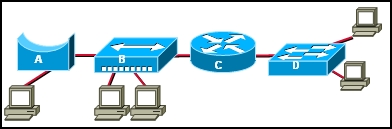 1. Refer to the exhibit. Identify the devices labeled A, B, C, and D in the network physical documentation. | |
| A=bridge, B=switch, C=router, D=hub | |
| A=bridge, B=hub, C=router, D=switch | |
| A=bridge, B=router, C=hub, D=switch | |
| A=hub, B=bridge, C=router, D=switch |
~0~
| 2. The central hub has malfunctioned in the network. As a result, the entire network is down. Which type of physical network topology is implemented? | |
| bus | |
| star | |
| ring | |
| mesh |
~0~
| 3. A switch has failed in the network. As a result, only one segment of the network is down. Which type of physical network topology is implemented? | |
| bus | |
| ring | |
| star | |
| extended star |
~0~
| 4. Which three features apply to LAN connections? (Choose three.) | |
| operate using serial interfaces | |
| make network connection using a hub | |
| limited to operation over small geographic areas | |
| provide part-time connectivity to remote services | |
| typically operate under local administrative control | |
| provide lower bandwidth services compared to WANs |
~0~
| 5. What is one advantage of defining network communication by the seven layers of the OSI model? | |
| It increases the bandwidth of a network. | |
| It makes networking easier to learn and understand. | |
| It eliminates many protocol restrictions. | |
| It increases the throughput of a network. | |
| It reduces the need for testing network connectivity |
~0~
| 6. What makes it easier for different networking vendors to design software and hardware that will interoperate? | |
| OSI model | |
| proprietary designs | |
| IP addressing scheme | |
| standard logical topologies | |
| standard physical topologies |
~0~
| 7. Which term describes the process of adding headers to data as it moves down OSI layers? | |
| division | |
| encoding | |
| separation | |
| segmentation | |
| encapsulation |
~0~
| 8. What is the term used to describe the transport layer protocol data unit? | |
| bits | |
| packets | |
| segments | |
| frames | |
| data streams |
[ad#ciemny-banner-1]
| 9. Which of the following are layers of the TCP/IP model? (Choose three.) | |
| Application | |
| Physical | |
| Internet | |
| Network Access | |
| Presentation |
~0~
| 10. Which of the following are data link layer encapsulation details? (Choose two.) | |
| A header and trailer are added. | |
| Data is converted into packets. | |
| Packets are packaged into frames. | |
| Frames are divided into segments. | |
| Packets are changed into bits for Internet travel. |
~0~
| 11. Which layer of the OSI model provides network services to processes in electronic mail and file transfer programs? | |
| data link | |
| transport | |
| network | |
| application |
~0~
| 12. Which two features apply to WAN connections? (Choose two.) | |
| operate using serial interfaces | |
| make network connection using a hub | |
| limited to operation over small geographic areas | |
| typically operate under local administrative control | |
| provide lower bandwidth services compared to LANs |
~0~
| 13. Which of the following are ways that bandwidth is commonly measured? (Choose three.) | |
| GHzps | |
| kbps | |
| Mbps | |
| Nbps | |
| MHzps | |
| Gbps |
~0~
14. Refer to the following list. Choose the correct order of data encapsulation when a device sends information.
| |
| 1 – 3 – 5 – 4 – 2 | |
| 2 – 1 – 3 – 5 – 4 | |
| 2 – 4 – 3 – 5 – 1 | |
| 4 – 3 – 1 – 2 – 5 | |
| 4 – 1 – 3 – 5 – 2 | |
| 3 – 5 – 1 – 2 – 4 |
~0~
 15. Refer to the exhibit. Which column shows the correct sequence of OSI model layers? | |
| A | |
| B | |
| C | |
| D |
~0~
| 16. Which layer of the OSI model provides connectivity and path selection between two end systems where routing occurs? | |
| physical layer | |
| data link layer | |
| network layer | |
| transport layer |
~0~
| 17. Which best describes the function of the physical layer? | |
| Defines the electrical and functional specifications for the link between end systems. | |
| Provides reliable transit of data across a physical link. | |
| Provides connectivity and path selection between two end systems. | |
| Concerned with physical addressing, network topology and media access. |
Dodaj komentarz